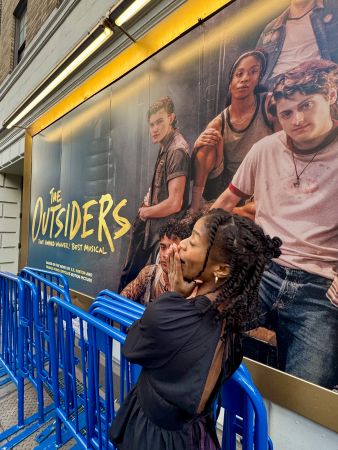
With seemingly endless crises competing for our attention, the mandate to “stay gold” is often easier said than done. The phrase, immortalized in S.E. Hinton’s classic novel The Outsiders and now sung nightly on Broadway in its Tony Award-winning musical adaptation, is a reminder to preserve one’s innocence, vulnerability, and hope against all odds. What does it actually mean to protect your light when the surrounding environment is defined by grit?
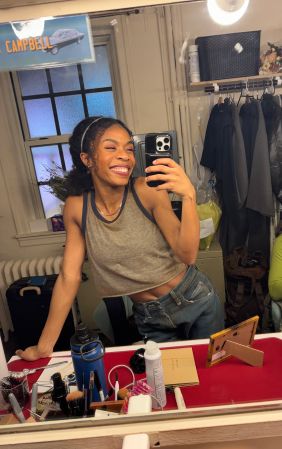
For Runako Campbell, actress and ensemble member in Broadway’s hit production of The Outsiders, answering that question is both a nightly artistic challenge and a daily personal practice. Performing in a show that mirrors the raw realities of socioeconomic struggle, trauma, and grief, Campbell is exploring what it means to remain soft in a world that demands armor. Speaking with MadameNoire, Campbell opened up about bringing a Black woman’s perspective to a historically white, male-dominated narrative, balancing the demands of a Broadway schedule, and her dedication to making her mark in the world.
The story of The Outsiders has captivated audiences for decades, largely due to its exploration of brotherhood, chosen family, and the friction between the haves and the have-nots—represented by the working-class Greasers and the affluent Socs. For generations of readers, the text has also been a staple of adolescent education.
Love Entertainment? Get more! Join the Majic 107.5 / 97.5 Atlanta Newsletter
Thank you for subscribing! Please be sure to open and click your first newsletter so we can confirm your subscription.
“I think I remember when I read it, I believe it was sixth grade,” Campbell recalls. “So I think anywhere from sixth to seventh grade, a lot of people start engaging with the material. And then the musical is just a way to like—we’re infusing singing and dancing, and tricks, and fighting—so I can see how it’s just such an engaging thing to want to be a fan of, you know?”
Due to this deep-rooted nostalgia, the production has generated a passionate, multi-generational following that the cast connects with via weekly social media broadcasts. “It’s been really great! I think what’s unique about The Outsiders is that we do have a very excited fan base of mostly younger people,” Campbell says. “Really, people of all ages, but definitely there’s a large teenage crowd, early 20s crowd. So it’s just been cool to connect with them a little more directly. Obviously, I’m not a lead role, but even as an ensembleist in the show, everybody has a name, right? So, I play Ace. Another ensembleist, for example, might be named Steve. So they still get that FaceTime with us who might not have as much text on screen, but you can still get a little bit of our personalities. And it’s been great to kind of grow that relationship with the fan base.”
As “Ace,” Campbell occupies a unique space within the narrative. The original 1967 novel focuses heavily on young male dynamics, leaving a Black female performer to intentionally build her own historical and emotional context within 1960s Tulsa, Oklahoma. Rather than viewing the ensemble role as a limitation, Campbell treats it as a rich canvas for exploration.
“I think being not just a Black girl on stage, but a poor Black girl in Tulsa in 1967—I feel like that’s already so layered, so I have to take into account I’m looked at differently, not just because of the clothes that I’m wearing or because I have dirty shoes, but also because I’m Black.”
To honor that reality, Campbell injects nuance into every movement, offering a necessary intersectional perspective to the story’s themes of class warfare. “I always try to think about what that must have been like at the time, and I really try to channel all of those emotions—from the way that I walk, to the way that I carry myself, to the way that I seek protection from my friends. But also, I’m a little defiant with some of the ways that they talk, you know, as boys. I think it’s both. It’s like I crave community as somebody who doesn’t have a lot, but I also know that I will never fully fit in with them, given that I am a girl who will one day be a woman.”
Through this delicate balance of defiance and vulnerability, Campbell highlights the broader thematic lessons the show offers modern audiences regarding structural hardship and emotional maturity.
“It’s about the struggle between your chosen family and your social group, or staying true to yourself and your beliefs. Sometimes you’re in a group of people and you feel very influenced by them, whether or not you’d like to be,” she says. “I also think it’s about—it’s not as simple as good versus evil and right versus wrong. Sometimes it’s very complicated and layered, and I feel like the show touches on that as well. But I think one of my favorite things about it is it touches on the power of possibility. There are some people who might not think they deserve possibilities. There are some people that might not feel like they can dream bigger based [on] their given circumstances. I love that this show encourages you to not give in to those struggles and always, always try to see another side of your situation.”
Defending the Self Against the Machine
Stepping into those heavy emotional spaces many times a week takes a toll, particularly when coupled with the intense physical demands of the production’s choreography. For Campbell, protecting her physical and mental well-being requires a strict boundary between her identity as an individual and her output as a performer.
“Sometimes it can feel like I truly live at the theater, which as you know, or as you may not know, it’s dark, it’s cold, you’re not getting a lot of vitamin D. I always try to have some kind of time outside every day if I can, for at least 20 minutes. I try to move my body for me when I’m not at the theater, because it’s obviously very important to train your body so that you’re not getting injured in the show. But I also think doing things like yoga and Pilates—just because I like how it feels—also kind of keeps my head clear.”
Now on her third Broadway production, Campbell emphasizes that discovering the necessity of a life disconnected from the stage was a learned behavior, important for escaping the consuming nature of the industry.
“I think just trying to keep as rich of a life as I can outside of the theater makes me feel like I’m a person, and not just a part of this machine that is a Broadway show, you know? I think it’s taken me about three shows in at this point—The Outsiders is my third show—to kind of understand how much I need to be resting, how much I need to try to see somebody who I don’t work with, to keep me feeling grounded.”
This grounding is what enables Campbell to face the socio-political climate outside the theater doors. Holding a degree in African American Studies from Princeton University, her artistic journey remains deeply intertwined with a commitment to advocacy and political consciousness. Yet, she candidly admits that maintaining optimism in modern times requires active resistance against fatigue.
“Yeah. You know, I have to admit, sometimes it’s hard for me to ‘stay gold,’ right?” Campbell confesses. Rather than succumbing to despondency, Campbell translates her political education into immediate, localized action, viewing “staying gold” not as a passive state of mind, but as an intentional, everyday choice.
Courtesy of Runako CampbellCourtesy of Runako Campbell
“It’s a daily practice of ‘how can I still engage? What can I do in my community today? Where can I be volunteering? Where can I spend my money?’ Every day it’s a little bit of a battle, but I know that the state of the world is calling on all of us—every single person. I think it’s very useful, the phrase ‘stay gold,’ because it’s easy to become hardened, and I don’t want that for myself.”
Redefining the Broadway Experience
It is this refusal to become hardened that beams through the production, transforming The Outsiders from a standard musical into a transformative experience for theatergoers. When asked what she hopes audiences communicate to their inner circles after witnessing the production, Campbell shares a desire to alter perceptions of what musical theater can achieve.
“I would hope that they say that the show took them on a ride,” Campbell says. “I would want them to say that they left feeling inspired and hopeful. Maybe a little teary-eyed, too—I think the show can be a bit of a tear-jerker. And I also think that they’re wowed by the effort that they saw on stage from everyone in terms of singing, dancing, acting. I hope that they leave with a new perspective on theater—on musical theater specifically.”
The production challenges traditional Broadway conventions, grounding its musical numbers in character necessity rather than spectacle.
“I think our show, it’s not as presentational and flashy in the traditional Broadway glamorous sense,” Campbell reflects. “I think it’s very gritty, I think it’s very real and honest. And anytime somebody bursts into song, it’s not necessarily for showing something to the audience, but it’s more so to show the relationships between the characters on stage. I hope that they walk around saying, ‘Oh, I’ve never seen a musical quite like that before, and it makes me want to see more musicals.'”
To stay gold in these times is not to ignore the dirt, the cold, or the grit of the world; rather, as Campbell demonstrates, it is the conscious decision to step outside into the sunlight, protect your community, and stubbornly refuse to let the machine harden your heart.